.jpeg)
Enhancing Understanding of the Intersection between Human Rights and Mental Health
This report outlines the discussions, reflections, and key takeaways from a specialized training session focused on Enhancing Understanding of the Intersection between Human Rights and Mental Health i
Brain Story
Author
This report outlines the discussions, reflections, and key takeaways from a specialized training session focused on Enhancing Understanding of the Intersection between Human Rights and Mental Health in Guri’el district, Galmudug State. The session aimed to foster inclusive dialogue, raise awareness to address inequalities, advocate for the dignity and well-being of individuals especially medical workers, community leaders, persons with disabilities and marginalized groups.
A key focus was the intersection of human rights and mental health, emphasizing the need for a rights-based approach to mental health policy and service provision. In Guri’el, mental health institutions and services are extremely limited. Individuals living with mental health conditions often experience social exclusion, neglect, abuse, and are frequently subjected to harmful traditional practices such as detention. These circumstances represent a violation of human rights and underscore the broader neglect of mental health within both development and humanitarian agenda.
The training brought together 20 participants, including health professionals and community members, with the goal of sparking public dialogue around the deeply rooted stigma and neglect faced by individuals with mental health conditions in Guri’el district, Galmudug State. The initiative seeks to emphasize that mental health is not only a health issue but also fundamental human rights.
The contextual aspect of the Guri’el district which is a centralized city links Ethiopia border, Mogadishu and entire Galmudug State. Being significant and strategic location of the city, it suffers from an extreme lack of mental health facilities/services but there are occastions where private hospital (Shifa) provide limited counseling and there are rare visits of external doctors on appointments.
Persons with mental health conditions in Guri’el frequently face Social exclusion, stigma, Abuse and neglect also exposure to harmful traditional and religious practices. These behavours violate human rights and reflect a broader neglect of mental health issues in both development and humanitarian agendas.
The training session was intended to promote inclusive community-based dialogues on human rights and mental health challenges. The stigma and neglect associated with mental health conditions emphasize mental health as a fundamental human rights, not just solving health concerns but also build commnunity awareness, advocate for sustainable and accessible mental health services.
Since there is limited menatl health services, approximately 70% of the community representatives that were met in Guri’el recognized the importance of mental health care. However, due to the absence of formal support systems, individuals often seek support to Quranic centers and religious leaders for spiritual healing. Also seeking treatment in major cities like Mogadishu (when financially possible) or else home detention.
These coping mechanisms underscore the urgent need for localized, formal mental health services, establishment of dedicated mental health facilities, implementation of regular community awareness programs, access to psychoeducation and psychotherapy services, creation of trauma healing centers, training for health workers in Mental Health First Aid (MHFA).
This initiative could marks a crucial step toward addressing the long-lasting neglect of mental health in Guri’el. It also calls upon policymakers, humanitarian actors, and civil society to recognize and act on the reality that mental health is a human right and access to care must be equitable, inclusive, and sustained.
Participants in the session represented a broad cross-section of the community and they composed of 20 persons (12 female and 8 male ). Below are their categories
• Respected Community Leaders ( Traditional elders, local adminstartion, religious leaders)
• Healthcare Professionals ( MCHs, public health staffs, nursing)
• Community Marginalized Groups leaders
• Representatives of Persons with Disabilities including the chair person.
Youth groups and women representative groups.
The diversity of the participants created a valuable space for open dialogue, leading to a more profound understanding of the challenges faced by vulnerable groups. A key issue raised was the frequent use of derogatory language and labels, especially toward people with disabilities. The chair person of the disability group and disability rights advocate shared that, “People call me ‘Lugey,’ a term I find extremely offensive. I have a name. My disability does not take away my identity or humanity.”Statements like this illustrate how harmful language can cause deep psychological pain and reinforce social exclusion.
17 out of 20 participants noted that discriminatory behavior is often normalized within the community, with limited awareness of its damaging effects. This lack of understanding continues to fuel emotional distress, social isolation, and a diminished sense of self-worth among marginalized individuals, particularly those with disabilities.
Participants also stressed the urgent need for accessible, high-quality health services particularly mental health support, trauma healing centers, psychotherapy, and physiotherapy centers. 7 out of 20 participants in the training shared personal stories of living with conditions like poliomyelitis, emphasizing that proper rehabilitation could significantly enhance both physical and emotional well-being. Unfortuntely, these services are currently unavailable in Guri’el and across the entire Galmudug state.
Involving community local leaders, under represented groups, and people with disabilities early on the project resulted inclusivity, relevance and community- based ownership.
Inclusive forums with various stakeholders created safe spaces for education, social ineraction and changing negative perception towards mental health conditions.
Empowering youth and survivors as mental health champions increased community outreacch and social cohesion.
Trained local volunteers had a passion to reach others living in rural areas and share for what they have been gained from the training sessions, group discussions and class activities, so that they can advocate them for their future concerns.
Distribution of pre and post-activities to the participants enabled us to measure on how the communities understand the concerns regarding mental health and human rights. Below is the attached class activities that shared by the participants. 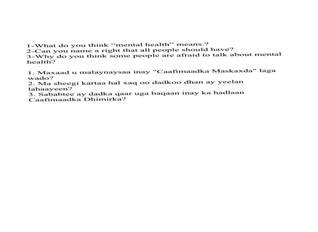
We learnt making a regular internal reports that tracked progress, captured feedback, and informed project adjustments. Also learnt sharing survivors stories while resepceting their privacy and with consent honored their voices to protect their dignity.
One of the participants, a mother from a marginalized community, shared a deeply painful story that reveals the lasting psychological impact of stigma and discrimination. She said; “One day, my young son came home from school/ Dugsi and asked me, ‘Mom, when we die and come back to life, can we change our tribe from Tumaal/ Madhiban to Sacad.? This heartbreaking question reflects more than a child's confusion it exposes the deep wounds caused by social exclusion. It illustrates how entrenched stigma can affect a child’s self-worth and identity, planting the seeds for long-term emotional and mental health challenges. Such stories highlight that discrimination is not just a social issue it is a human rights violation with serious psychological consequences. The pain has been treated as inferior solely due to one's background can cause deep emotional harm, leading to long-term trauma and mental health issues especially when such experiences are not met with compassion, fairness, and inclusive support.
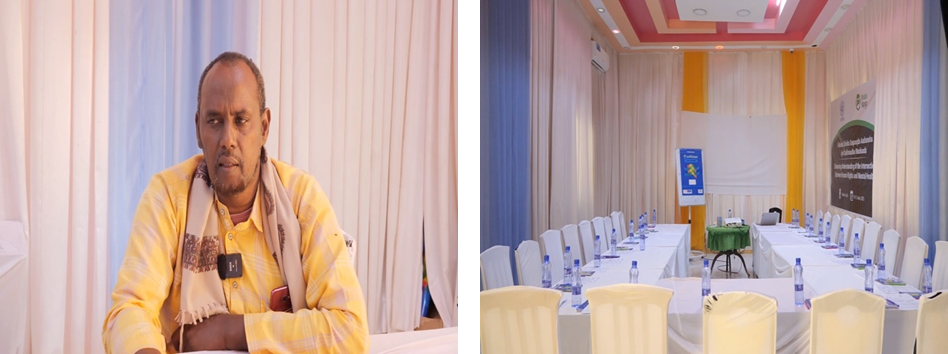
We created a WhatsApp group that participants shared ideas, sent to training documents and check for their presence in the training venue.
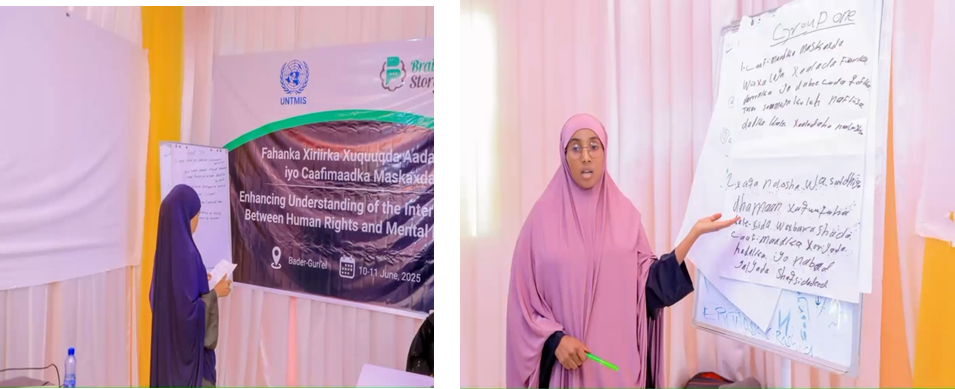
Trainees feedback
The experiences gained both challenges and successes form a strong foundation for future programming, policy influence, and regional replication. The voices of youth, survivors, and community actors have been central to this journey, and their courage continues to inspire action toward a more mentally healthy and rights-respecting society.
This training served as a powerful reminder of the importance of empathy, inclusion, and the protection of human dignity. Through these experiences and voices shared, we leant they should not be forgotten and call to action for community transformation.
Challenges and recommendations:
Challenges;
Social Exclusion and Inequality, It was noted that deep-rooted beliefs around clan, status, and identity continue to influence societal dynamics. Participants from marginalized backgrounds reported feeling excluded such as; intermariages and lack representation in socio-political rigts. One of the training participant said “They behave us like we are not part of them. It’s as if only some people are entitled to access dignity and opportunity.”
Recommendations
Establish cultural-sensitive awareness among communities to promote respectful language and behavior.
Advocate for the establishment of physiotherapy centers in respective districts.
Integrate human rights education into social behavour, health facility polices, educational intitutions as well as school curricula.
Ensure inclusive policies in district adminstration to protect individuals from discrimination based on disability, background, or social status.
Provide regular mental health and psychosocial support, especially for those who felt exclusion and traumatized.